
Guide To AI Job Search Tools
A Guide by Situation — Not by Rankings
Most job seekers grab the wrong tool for their situation and then wonder why nothing improves. This guide cuts through the noise and tells you exactly what to use based on where you actually are in your search.
By Chester Liu, Founder of Hirecarta
There are now dozens of AI job search tools. Resume builders, ATS scanners, bulk appliers, tracking boards, career coaches — each one promising to fix your job search if you just sign up.
Most of them are genuinely good at something. The problem is that people consistently pick tools designed for a different problem than the one they actually have. You optimize your ATS score when fit is the issue. You download a tracking tool when you barely have any applications to track. You speed up your applying when speed was never the bottleneck.
This guide skips the rankings. Instead: find your situation below, read that section, skip the rest.
"I just got laid off"
You don't even have a resume — or the one you have is five years old and lists a job you've long since moved past. So you do what everybody does: you Google "resume builder," click the first few results, and start poking around.
And honestly? The templates are gorgeous. Clean layouts, tasteful fonts, little icons next to your contact details. Tools like Rezi and Kickresume do genuinely great design work, and it feels good to see your name at the top of something that looks polished and professional. For a few minutes, the whole job search feels manageable.
Here's the thing recruiters will never tell you: they spend an average of six to eight seconds on a first resume scan, and they don't notice the template at all. What they're looking for is whether you've done the right things, at roughly the right scale, for roughly the right kind of role. The container doesn't matter much. What's inside does.
A beautiful resume built around a weak or unfocused narrative is still a weak resume.
The mistake people make right after a layoff isn't using resume builders — those tools are genuinely useful once you know what you're saying. The mistake is jumping straight to formatting before getting clear on the story. What are you actually good at? Where do you want to go next? Why would a hiring manager at a specific company care about your particular background?
You have maybe a few weeks before financial pressure kicks in, and the instinct is to move fast. But slow down for one week. Not to rest — to get this right.
A better starting point is a platform that helps you build a full professional profile first — your skills, experience, career arc, what you actually want next — and then generates job-specific documents from that foundation. The profile is the raw material. Once it's solid, generating a resume tailored to a specific role takes minutes instead of hours, and the result is something a recruiter will actually respond to: a clear story, matched to something they're hiring for.
"I've been applying for months and I'm not hearing back"
You started this the right way. You were careful. You read each job description thoroughly, tailored your resume, wrote real cover letters. You triple-checked everything before hitting submit.
And then... silence. Week after week. So you started to wonder if maybe you were being too slow, too deliberate. Maybe the answer is volume. Maybe if you just sent more, the math would eventually work in your favor. Now you're looking at auto-apply tools, or you've gone deep on ATS optimization — convinced the keywords are the thing standing between you and a callback.
This is the most common and most demoralizing trap in job searching. And it's worth naming clearly before you spend another week on it.
Here's something most people don't realize: ATS optimization and job fit analysis are completely different things — and confusing them is probably why you're stuck.
Keyword matching is what tools like Jobscan do. You paste in a job description, they scan your resume, and they tell you which words from the posting are missing from your document. If the job says "stakeholder management" and your resume says "cross-functional communication," that's a gap — even if you've been doing the exact same thing for five years. Jobscan is genuinely good at this, and fixing keyword gaps is a real part of getting past automated screening.
Example: You apply for a "Data Analytics Manager" role. Jobscan gives you a 58% match because your resume says "reporting" instead of "analytics" and "team lead" instead of "manager." You swap in the right words, resubmit, and your score jumps to 84%. That's keyword matching doing its job.
Job fit analysis is different. It's not about vocabulary — it's about whether your actual background maps to what the role genuinely requires. Did you manage the scale this job demands? Do your skills cover the core responsibilities, even if they're described differently? Would a hiring manager, looking past the keywords, see you as a credible candidate?
Example: You have five years running operations for a regional logistics company. You apply to a "Supply Chain Strategy" role at a consulting firm. Your keyword score is low because your resume doesn't use consulting language. But your experience — vendor negotiation, cross-regional coordination, cost reduction — is exactly what the role needs. A keyword scanner says poor fit. An intelligent fit analysis says strong fit.
Here's the hard truth: you can score 90% on keyword matching and still get no callbacks, because you're applying to roles where your background isn't actually right. And you can score 50% and land interviews, because the fit is real even if the vocabulary doesn't line up yet.
Before you change any tools, audit your last ten applications honestly. Were those roles a real match for where you are in your career — not just surface-level, but did your actual experience cover what the job required? Were you customizing your resume and cover letter per posting, or sending the same document everywhere?
If the answer to either question is no, that's your bottleneck. The fix is job fit analysis paired with real per-job customization — not faster applications, more targeted ones. Curated, well-matched applications get roughly 50-100% higher response rates. The math strongly favors doing less, better.
"I want to change careers, but I'm not sure I'm qualified"
Career changers have a specific problem that most tools aren't built to solve: translation.
Your experience is real. But it's described in the language of your old industry. You've spent five years in logistics and want to move into operations consulting. You have everything you need — supply chain management, cross-functional coordination, vendor negotiation — but your resume reads like a logistics resume, not a consulting resume. Recruiters can't always see through that gap. And neither can most AI tools.
Standard resume builders and ATS optimizers assume you already know your target and your story is already positioned correctly. They optimize what you give them. If your background uses different vocabulary than the job posting — say, your "airline operations" experience versus a posting that says "transportation sector management" — keyword matching will tell you you're a poor fit even when conceptually, you're a strong one.
What career changers actually need is a tool that understands your background at a conceptual level — not just the keywords on the page, but what your experience actually demonstrates — and can map that to roles that legitimately fit. Then, from that understanding, generate a resume and cover letter that presents you in the right framing for the new direction.
This is where the gap between a resume builder and a full career platform becomes most obvious. A formatting tool can't do this. You need something with coaching-level career positioning built into how it generates documents. Once you have that, the translation problem mostly solves itself.
"I have a job. I'm just quietly looking."
You're not in crisis mode. You're selective. You have maybe a few hours a week, you can't be visible about it, and you'd rather spend that time well than blast out ten applications that go nowhere.
The trap people in this situation fall into is tracking tools. They sign up for Huntr or Teal — both legitimately solid for organizing a pipeline — and spend two hours building a beautiful kanban board for their job search. Then they realize they only have three applications to put in it and haven't done any of the upstream work of figuring out which jobs are actually worth pursuing.
They also don't know that Kanban is only good for 3-7 items per column. Managing 100's of applications is impossible!
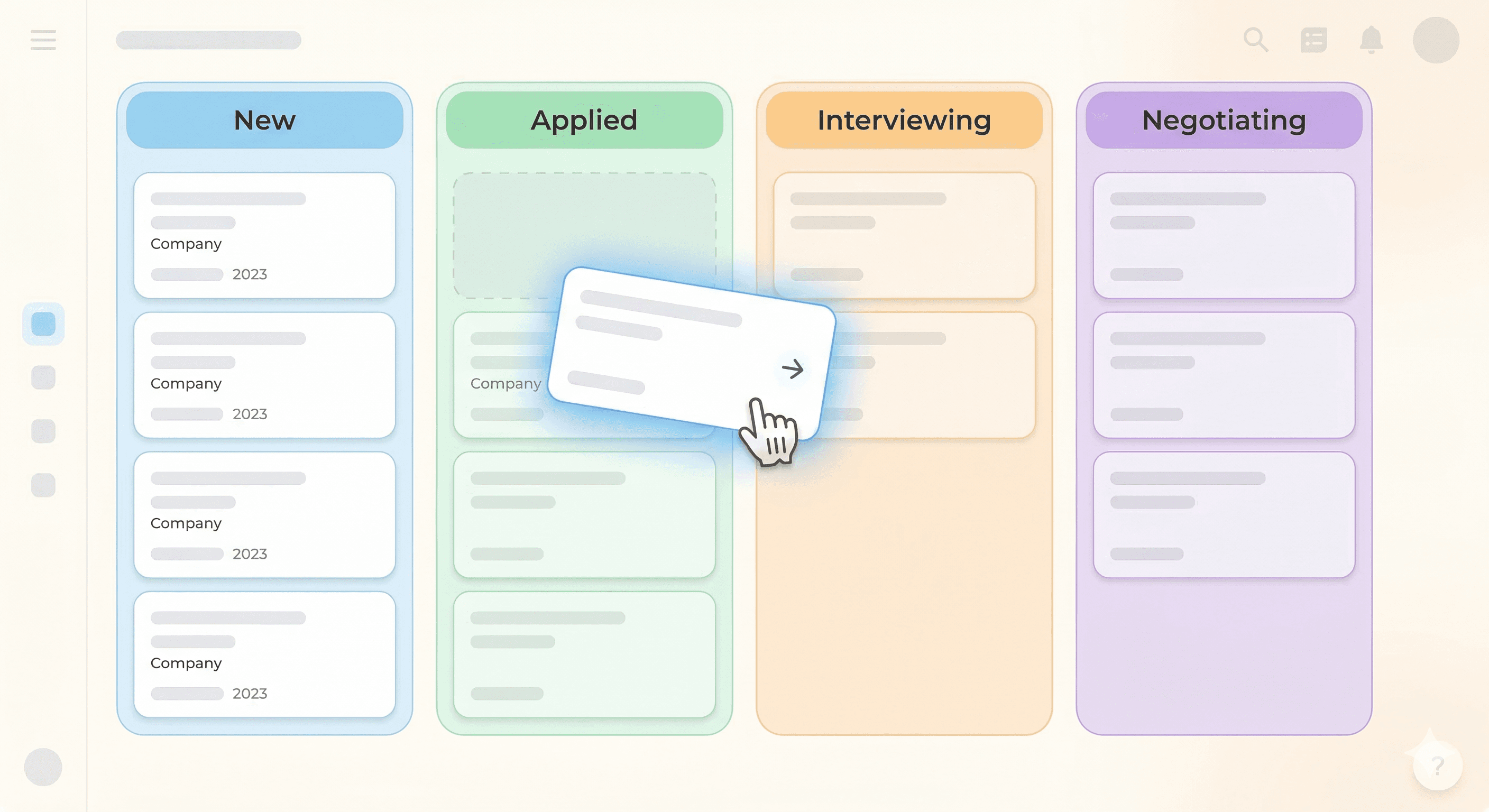
Tracking tools are useful. But they're a downstream solution. They organize applications you've already decided to make. The more important question for a selective job seeker is: how do you identify which roles are worth your time before you invest a few hours customizing materials for them?
That's where job fit analysis matters most. The ability to paste in a job description, compare it against your background, and get a real read on fit — before you commit to writing anything — saves enormous time. For someone applying to five or six roles over a few months, getting that evaluation right is worth more than any pipeline feature.
And when you do decide a role is worth your time, your materials need to be genuinely excellent. You're applying to fewer things, so each one carries real weight. A properly customized resume and cover letter — built for that specific role, not lightly adapted from a template — is the difference between advancing and being filtered out in the first round.
The tool landscape, honestly
Here's the plain breakdown of what each category actually does:
| Tool Category | What It's Good At | Where It Falls Short |
|---|---|---|
| Resume Builders (Rezi, Kickresume) | Polished design, fast AI content generation, ATS formatting | One-size resume — no per-job customization, no fit analysis, no coaching |
| ATS Optimizers (Jobscan) | Keyword gap analysis vs a specific job description | Checks keyword presence, not whether you're actually right for the role |
| Bulk Apply Tools (AiApply, Simplify Copilot) | Speed — lots of applications fast | ~2% response rate without fit and customization behind it |
| Job Matching (Jobright) | Surfacing relevant jobs based on your profile | Limited document generation, no career coaching |
| Application Trackers (Huntr, Teal) | Organizing your pipeline, notes, follow-ups | Purely organizational — no AI, no documents, no coaching |
| Integrated Platforms (Careerflow) | Resume + cover letter + tracking + basic interview prep | Limited career coaching, no real career strategy layer |
| Career Platforms (Hirecarta) | Full stack: fit analysis → tailored documents → coaching → interview prep | Requires building your profile first — not a quick-start tool |
One honest note on full career platforms: there's real setup work upfront. You need to actually build your profile before the system can do its job well. If you need to send applications today, that's not where to start. But if you're playing a longer game — and most job searches run three to six months — the difference between having everything connected and stitching together four separate tools that don't talk to each other adds up quickly.
The short version
Every job search tool is solving one of three problems: document quality, process efficiency, or strategic fit.
Most people focus on efficiency — how do I apply faster, how do I track more? — when their actual problem is fit or quality. Their ATS scores go up. Their application volume increases. Their response rate doesn't move.
Figure out where you're actually stuck. That's the only tool question that matters.
Frequently Asked Questions
I'm not getting responses. Where do I start?
Before you change tools, do a fit audit. Look at the last ten jobs you applied to and ask honestly: was my background a real match for what those roles required? And did I actually customize my resume and cover letter for each one — not just swap a few keywords? Those two things explain most ghosting situations long before any tool change matters.
What's actually different about job fit analysis vs ATS optimization?
ATS optimization answers: does my resume contain the right keywords? Job fit analysis answers: does my background genuinely match what this role requires? You can pass the keyword check and still be wrong for the job. The second question is the one that predicts whether a recruiter calls you.
Can I just combine multiple free tools and get the same result?
Yes, a lot of people do. The tradeoff is that each tool works in isolation — your resume builder doesn't know what your tracker knows, and neither knows what your ATS score means for your actual fit. An integrated platform where your profile drives everything tends to catch the gaps that four separate tools miss.
What's the best approach for a career changer?
Career changers need two things most tools don't offer together: positioning help (reframing experience for a new direction) and conceptual fit analysis (identifying which roles your background can credibly support). A resume builder will format whatever you give it. What you need is something that understands your experience at a deeper level — not just the vocabulary on your resume.
Is paying for a tool worth it?
Depends. A $10/month ATS scanner is worth it if keyword gaps are your actual problem. A broader platform is worth it if you want fit analysis, document generation, and coaching without spending two hours a week juggling separate tools.