
'Responsible For' on a Resume
Why It Weakens Your Bullets (and What to Write Instead)
By Chester Liu, Founder of Hirecarta
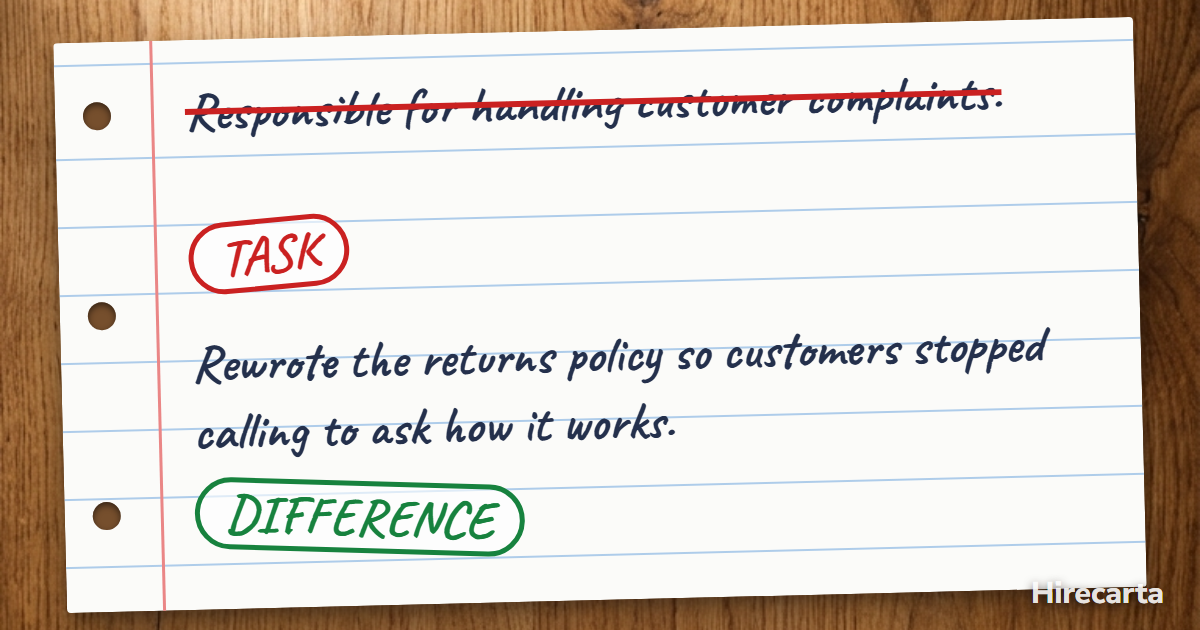
Two people apply for the same job. Same school. Same years of experience. Same title on their last role.
One resume says: "Responsible for handling customer complaints."
The other says: "Rewrote the returns policy so customers stopped calling to ask how it works."
Only one of them tells the reader what happened because that person was there. The first describes a task. The second describes a difference. This post is about how to write the second kind, whatever your job is.
Task vs. Difference
"Responsible for" tells the reader what your job title already implied. A customer service rep handles complaints. A nurse cares for patients. A teacher teaches. Nobody reading your resume learns anything new from those lines, and they can't tell you apart from the other people who held the same title.
A task is what you were assigned. A difference is what was better, faster, clearer, or less painful because you were there.
Bullets that describe differences are easier to remember, easier to talk about in an interview, and harder to fake. That last part matters. A task is the same for everyone in the role. A difference is specific to you.
The "What Changed?" Test
If you are staring at a bullet that starts with "responsible for," answer three questions about that part of your job:
- What was broken, slow, missing, or confusing before you got there, or before you fixed it?
- What is different now because of what you did?
- Who noticed? Customers, teammates, your manager, the person who took over after you. What did they stop doing, or start doing?
Then write the bullet in this order: verb, what you did, what changed.
The pattern
Rewrote (verb) the returns policy (what you did) so customers stopped calling to ask how it works (what changed)
Not every answer will come with a number. That is fine. A clear before and after works without one.
Before and After Examples for Six Roles
These examples are illustrative. They show the shape of a strong bullet, not real results. Yours should come from your own work.
Warehouse
Responsible for picking and packing orders.
Instead: Moved the fastest-selling items closest to the packing station, so pickers walked less and orders shipped earlier in the day.
Retail
Responsible for opening and closing the store.
Instead: Rebuilt the opening checklist so the morning shift started on time without needing calls to the manager.
Office administration
Responsible for scheduling appointments.
Instead: Replaced the shared paper calendar with an online booking sheet, ending double-booked appointments.
Nursing
Responsible for patient care on a surgical unit.
Instead: Created a shift handoff checklist that the unit adopted for every shift, so night staff stopped missing follow-up tasks.
Teaching
Responsible for teaching seventh grade science.
Instead: Redesigned the science labs around materials the school already owned, so every student could run every experiment.
Software
Responsible for maintaining the checkout service.
Instead: Rewrote the checkout retry logic so failed payments recover on their own instead of paging the on-call engineer.
Notice that none of the rewrites needed a statistic. Each one names a problem and a change. If you can also say how much, add it. If you can't, the bullet still works.
When You Do Have Numbers
Numbers help when they are real. Here is one example where they are:
Replaced a manual spreadsheet routine with a script, cutting the weekly reporting task from about four hours to one.
If you decide to include a number, keep these rules:
- Use only numbers you can explain. If an interviewer asks how you arrived at it, you should have a straight answer.
- Round conservatively and say so. "About," "roughly," and "more than" are all honest.
- Find the source. Old emails, dashboards, performance reviews, and coworkers who remember the before and after are all good places to check.
- Cut it if you can't defend it. A bullet with no number is stronger than a bullet with a number you are afraid to be asked about.
This matters more now that AI tools rewrite resumes. In our study of 10 leading AI models, one model attributed an outcome to a bullet that the candidate's profile never stated. A rewrite that sounds impressive is not the same as one that is true. If you use an AI tool, give it your real answers to the three questions above, and reject anything you could not back up out loud.
Common Traps
Swapping the verb and nothing else. "Managed customer complaints" is the same task with a stronger-sounding word. The test is whether the bullet says what changed.
Vague adjectives. "Successfully," "effectively," and "various" add length without adding information. If something was successful, say what happened.
Hiding behind the team. Words like "helped," "assisted with," and "contributed to" can mean anything from writing the whole thing to bringing the snacks. Team results are fine, but the reader wants to know your part. "Helped launch the welcome emails" is weaker than "Wrote the welcome email series for the launch."
Five bullets with the same shape. A list of duties reads like a job description. Pick your two or three strongest differences per role and give them the space.
Listing tasks that have no story. Not every duty needs a bullet. If you can't say what changed, consider cutting the line and using the space for one that does.
Write Your Answers Once
The hard part is not the wording. It is remembering what you actually did, and that is easiest to do once, while it is fresh, instead of again for every application.
That is what a Master Profile is for: a record of your real roles, skills, and accomplishments, written in your own words. When you paste in a job description, Hirecarta drafts a tailored resume from what you wrote, not from what a model imagines. If you would like to see how a resume lines up with a specific job first, the free Resume Check needs no account.
Frequently Asked Questions
Is "responsible for" ever okay on a resume?
Yes, when the scope itself is the point, such as a summary line that says you were responsible for a team of five or a regional budget. Use it to set the scene, then follow it with bullets that describe what changed because of you. Don't use it as the opening of every bullet.
How do I write resume bullets if I have no numbers?
Describe the difference instead of the metric. Say what was broken, slow, or confusing before you, and what was different after. A clear before and after is more convincing than an invented percentage, and it is something you can explain honestly in an interview.
Can I use ChatGPT to rewrite my resume bullets?
You can, but check every rewrite against what actually happened. AI tools can add outcomes you never had. Give the tool your real answers to the "what changed?" questions, and reject any bullet you could not back up in an interview.
How long should a resume bullet be?
A good rule of thumb is one or two lines. If a bullet needs a third line, it usually contains two ideas and works better as two bullets.