
Rezi Review and Alternatives (2026)
Is the “Most Powerful AI Resume Tool” Actually Trustworthy?
By Chester Liu, Founder of Hirecarta
Short answer: Rezi has the best resume parsing and typography controls of any tool I've tested in this category, importing a real PDF preserved formatting almost perfectly. But:
- The free tier is nearly nonexistent: zero free cover letters, one resume, and ten AI generations for the life of the account, not per month
- The flagship "AI Resume Agent" hit its message limit before I could use it once
- The AI keyword targeting fabricated a specific production accomplishment, in a language the resume never mentioned
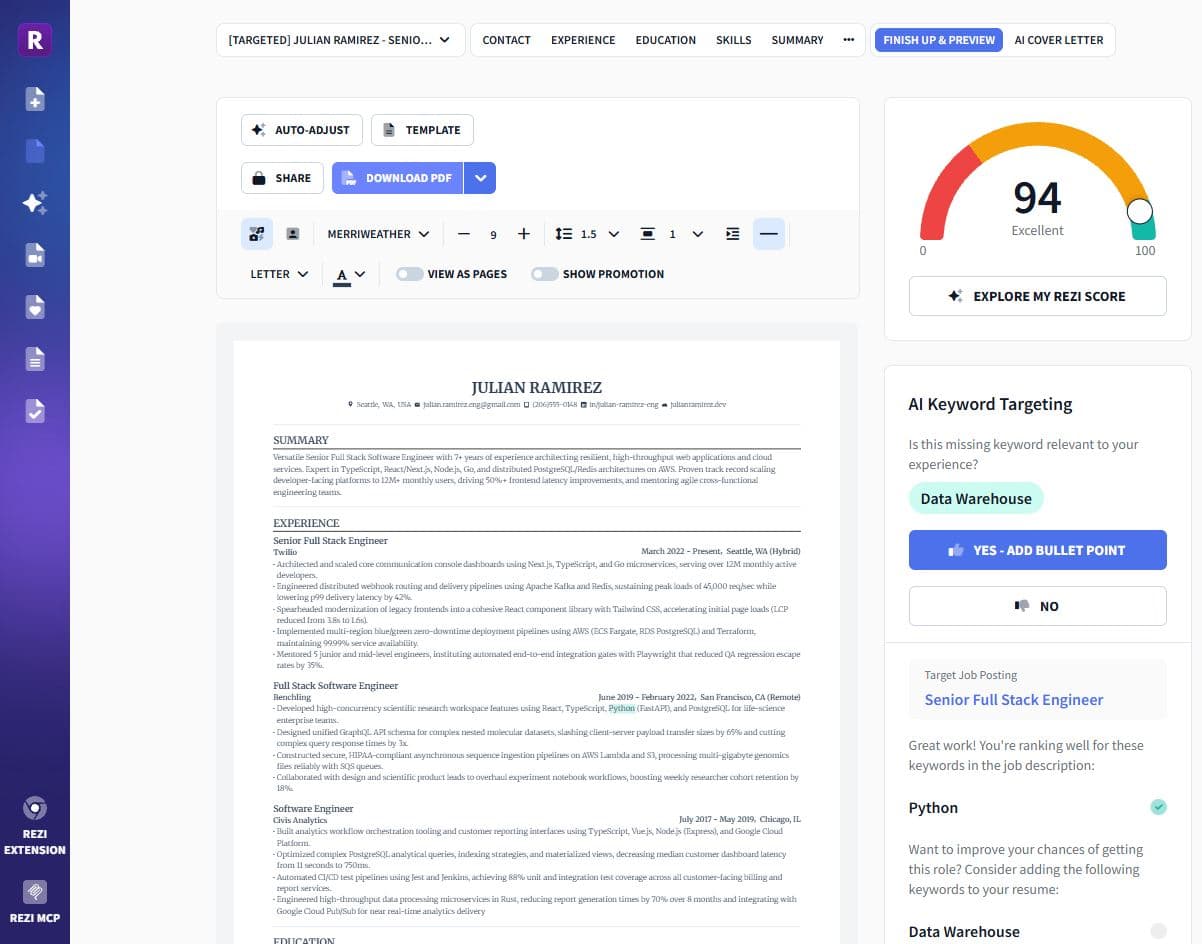
- That fabricated resume still scored 94 out of 100, "Excellent," on the one screen a user actually looks at, the real problems were hidden one click deeper than anyone has a reason to go
- A quota bug silently locked my own finished resume behind a paywall
This is a well-designed shell around some genuinely unreliable AI.
Here's my honest take.
What Is Rezi?
Rezi started in May 2015 as a weekend project aimed at a real problem: new graduates struggling to land jobs, and most job seekers not knowing how to write a resume that actually gets past Applicant Tracking Systems (ATS). A decade later, the pitch has expanded well beyond ATS-focused resume formatting: an "AI Resume Agent" chat tool, AI keyword targeting per job description, a "Rezi Score" that grades your resume, a job search board sourced from company career pages, an AI-driven mock video interview tool, and a separate paid human resume review service.
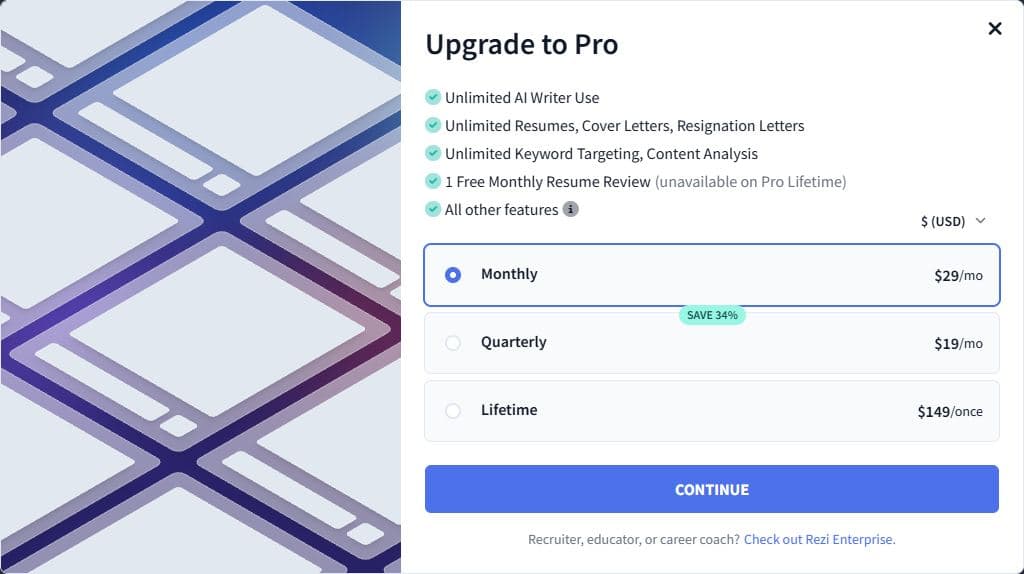
Pricing: $29/month, or $19/month billed quarterly (about $57 every 3 months, marketed as "Save 34%"), or $149 once for lifetime access, per Rezi's own subscription plans breakdown. There's a free plan, but as I'll get into, it's cut off almost everywhere that matters.
How Rezi Works
The core workflow:
- Upload a resume (PDF or Word) or start from the AI Resume Agent
- Optionally "target" the resume to a specific job title, company, and job description
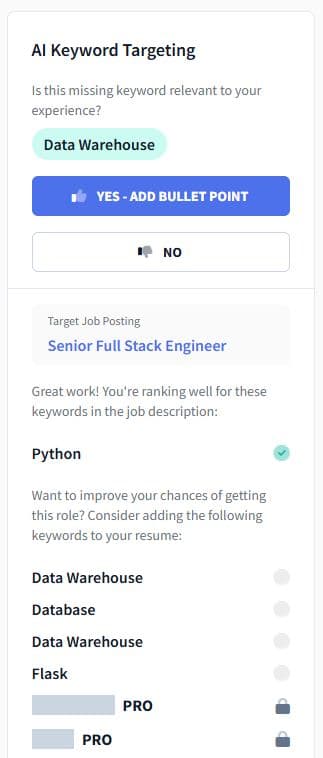
- Rezi's AI Keyword Targeting scans the job description and prompts you to accept or reject missing keywords, one at a time
- It writes a new bullet point for each keyword you accept
- A "Rezi Score" grades the finished resume out of 100
I tested this with a fictional but realistic resume (a Senior Full Stack Software Engineer background) targeted at a Senior Full Stack Engineer, Platform role, so I could watch exactly what the AI added and whether it stayed within the bounds of the source material.
Rezi Pricing: What You Actually Get
| Plan | Price | What's Included |
|---|---|---|
| Free | $0 | 1 resume, 10 AI generations total (lifetime cap, not monthly), 0 cover letters |
| Monthly | $29/month | Unlimited AI writer use, unlimited resumes/cover letters/resignation letters, unlimited keyword targeting |
| Quarterly | $19/month (~$57 billed every 3 months) | Same as monthly, "Save 34%" |
| Lifetime | $149 once | Same as monthly, except the 1 free monthly resume review is unavailable |
On top of a Pro subscription, Rezi also sells a separate human resume review service priced per word: $21.60 for a 5-day turnaround up to $99.36 for 12 hours on my test resume. Rezi's own documentation and its Jobscan comparison page both advertise this service as starting "from $8," which checks out as a floor for a very short resume at the slowest turnaround, not a realistic price for a full one- or two-page resume like the one I tested. Pro plans include one free review per month (not available on Lifetime), but anything beyond that is an extra line item on top of your subscription.
What Rezi Does Well
I want to be fair, because some of this is genuinely good.
Resume parsing is excellent. I uploaded a real, densely formatted PDF resume and Rezi reconstructed it almost perfectly on the first try, correct dates, bullet structure, section headers, contact links.
Typography control is a real step up. You can change font family, font size, line spacing, and margins directly in the builder. That's more control than Jobscan offers (line spacing and margins only) or Jobright (three ancient font choices, no color control).
The keyword targeting UI is clean and legible, even though, as you'll see below, what it does with an accepted keyword is the problem, not how it's presented.
Resignation letters are free and don't require a subscription to create, unlike cover letters.
What Frustrated Me About Rezi
The AI Fabricates Work Experience You Don't Have
This is the most serious issue, and it happened on the very first job description I tested.
My test resume's real work history includes TypeScript, React, Go, Python, PostgreSQL, and Kafka, nowhere does it mention Rust. When Rezi's AI Keyword Targeting flagged "Rust" as a missing keyword from the target job description and I clicked "Yes - Add Bullet Point," it generated this and inserted it directly into the resume, attached to a real past employer:
"Engineered high-throughput data processing microservices in Rust, reducing report generation times by 70% over 8 months and integrating with Google Cloud Pub/Sub for near-real-time analytics delivery."

None of it is true. Not the language, not the integration, not the 70% figure. This is the exact same failure mode I found in Jobright's resume customization, a tool inventing a concrete, specific-sounding accomplishment because a keyword appeared in a job description. If a candidate walked into an interview and got asked to talk through that Rust migration, they'd have nothing to say. It also lines up with what I found testing 10 leading AI models on the same resume prompt: even frontier models will fabricate a credential when a job description hands them the temptation.
A 94 "Excellent" Score Hides a Resume With Real Problems
Here's what a Rezi user actually sees by default: a resume containing the fabricated Rust bullet from above, next to a large gauge reading 94, "Excellent." That's it. That's the whole surface. Nothing on that screen tells you anything is wrong. To find out otherwise, you have to actively click a secondary button, "Explore My Rezi Score," something most people who just saw a green "Excellent" label have no reason to do.
Click through, and only then does a breakdown appear: Content scored 70, well below the other categories, with a flag reading "Your resume has 1 experience with weak bullet points, weak verbs will fail to explain your experience with meaningful language."
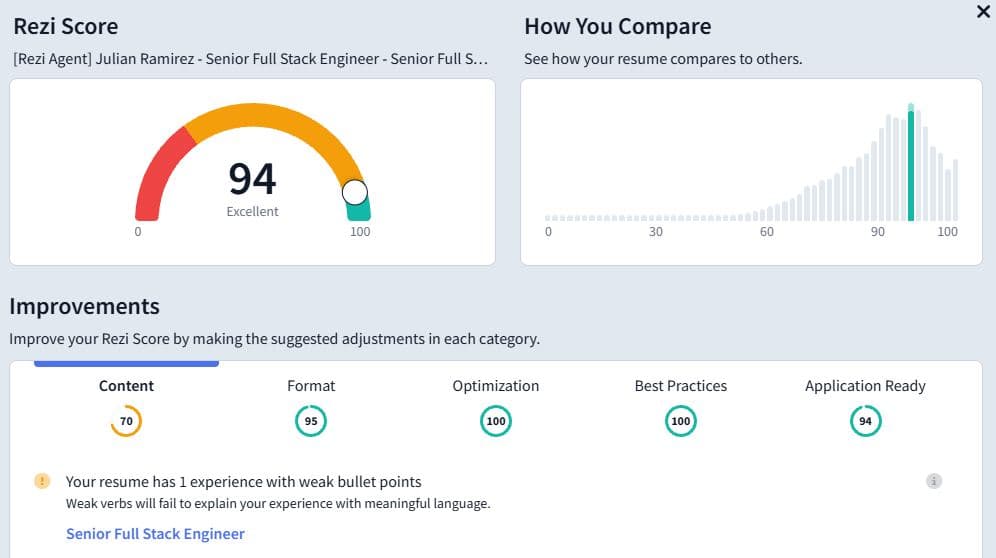
And even this hidden detail misses the real problem. "Weak bullet points" is a note about verb choice. Nowhere does Rezi flag that the bullet describes a language, a metric, and an integration that don't exist. The one signal a motivated user might dig for doesn't catch the one thing that would actually hurt them in an interview.
This isn't an ATS score, either, and what actually happens inside enterprise ATS software looks nothing like a single 0-100 gauge in the first place. To Rezi's credit, their own documentation says so directly: "real ATS systems don't give your resume an official score. Recruiters won't see the same percentage you see in Rezi, and there's no universal 'resume score' hiring teams use behind the scenes." That's an honest admission buried in a support article. It's nowhere on the screen where the score actually appears, which still presents a big number, a color-coded gauge, and a label with all the visual authority of a real verdict.
The same documentation explains why the number moves the way it does: the Rezi Score is wired to a "Real-Time Analysis tool" and updates continuously as the resume is processed, which is a reasonable design choice, but nothing in the product tells a first-time user that what they're looking at seconds after uploading might still be mid-calculation rather than final.
Rezi's own comparison page pitching Rezi over Jobscan goes further, describing the score as "23 specific criteria, you see exactly what to fix." What I actually saw was 5 categories, not 23, and most of the individual checks inside those categories, personal pronouns, buzzwords, passive voice, filler words, sat behind a Pro paywall even after I'd built a complete resume. "You see exactly what to fix" undersells how much of that visibility is locked.
Rezi's own homepage sells the Score feature with the line: "Know exactly where you stand. The Rezi Score breaks down your resume section by section. No guessing what's weak. You see it, then fix it." In practice, you see a 94 and a green label. Guessing what's actually weak requires an extra click most users won't make, and even then the real problem, a fabricated accomplishment, isn't part of what gets flagged. One of the homepage testimonials, from a user named Natalia, singles out "the rewritten AI bullet points and the keyword targeting" as her favorite features, the exact mechanism that fabricated the Rust bullet in my test. A user who trusts the number they're shown, and the testimonials telling them to trust it, has no way of knowing their resume isn't in the shape the score claims it is.
The AI Resume Agent Referenced a Company I Never Mentioned
Rezi bills the AI Resume Agent as "our most powerful AI resume tool." Its own documentation lists "share interview preparation tips based on your background and experience" as one of the things it can do, and suggests prompts like "Give me interview questions and prep tips for my target role." I'd have liked to test that claim directly, but on the accounts I used, the agent either hit its message limit before I could ask, or, in the one conversation that did go through, answered a question I hadn't asked yet. In a fresh chat, with no job description or company mentioned anywhere in that conversation, I asked it to help improve my resume. Its response opened with:
"Your resume is strong with 7+ years of full-stack engineering experience and expertise in TypeScript, React, and Tailwind CSS. To tailor it specifically for the Senior Full Stack Engineer role at Setpoint, a couple of key requirements from the job description are missing from your current experience: 1. Have you participated in rotating on-call shifts..."
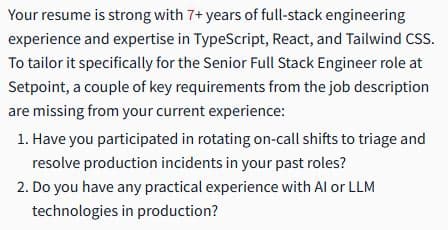
"Setpoint" was a job listing I had clicked "Target Resume" on earlier, from an entirely separate part of the app (Job Search), in a different session. The chat had no business knowing that name. Beyond the fabrication problem, this points to a state-management bug: the agent is pulling context from somewhere the user never provided it in the current conversation, and presenting it with full confidence as if it were reasoning from the visible chat history.
Separately, when I opened a brand new chat and asked "can you help me improve my resume" without attaching one, the agent replied: "Please paste your resume text here so I can bring it into your workspace and help you improve it." This is an account that already has a completed resume sitting in the dashboard. A tool marketed as an AI agent that doesn't check whether the user already has resume data before asking them to retype it by hand is not particularly agentic.
The Free Tier Has No Real Trial
Ten AI generations sounds like a number until you realize it's not per month, it's for the life of the free account. Cover letters are worse: there is no free allotment at all. Clicking "Create new Cover Letter" on a completely untouched account immediately shows an "Upgrade to Pro" paywall, not a limited trial, a hard wall.
That's not a small discrepancy from what Rezi advertises. Rezi's own subscription plans documentation lists "Rezi Cover Letter Builder" only under the Pro plan's features, not under Free. But Rezi's comparison page pitching itself against Jobscan claims the opposite in bold text: free cover letters are "Unlimited... Always free for every job." I tested this directly, on a completely untouched account, and got an immediate upgrade paywall on the first attempt. Two of Rezi's own pages disagree with each other about whether this feature is free, and neither one matches what the product actually does.
The AI Resume Agent fared no better, despite the same subscription documentation listing it as "AI Resume Agent (limited)" under the Free plan, implying some real usage. On one test account, simply trying to attach an existing resume to a brand-new chat, before sending a single message, triggered "You've reached your free message limit."
Compare that to Jobscan, which gives you 5 full scans free, or Jobright, which at least gives you 3 resume customizations before cutting you off. Rezi's free tier isn't a trial designed to show you the product working, it's a locked demo.
Nearly Every Meaningful Improvement Is Gated, Even After You're In
Open the full Rezi Score breakdown and you'll see checks for personal pronouns, buzzwords, passive voice, and filler words, four of the more genuinely useful writing-quality checks a resume tool can offer. All four are locked behind a padlock icon marked "PRO," alongside most of the additional keyword suggestions beyond the first handful.
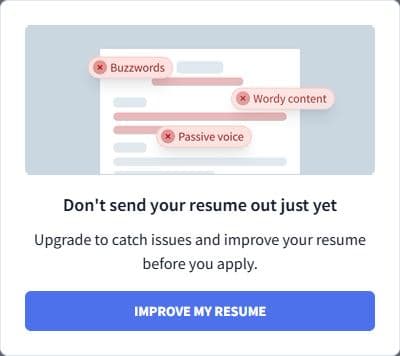
Even finishing a free resume triggers a nudge before you can download it: a "Don't send your resume out just yet" modal flagging buzzwords, wordy content, and passive voice as reasons to upgrade before you're allowed to feel good about hitting export.
Templates follow the same pattern: the free plan gets two options (Standard and Compact). The Rezi Modern Template and Harvard Format, arguably the two best-looking options in the library, are both marked PRO.
A Job-Search Feature Silently Broke My Own Resume Quota
This is the bug I'd most want a product team to see. From the Job Search tab, clicking "Target Resume" on a listing lets you pick an existing resume and have Rezi tailor a copy of it for that job, no warning, no confirmation that this counts against your resume limit.
It does count. After using it once, my account's usage counter read "RESUMES 2 / 1," over its own stated limit, and my original resume, the one I'd already built and was actively using, now showed a lock icon and demanded a Pro upgrade to reopen it. The new targeted copy, which is what actually pushed the account over the limit, remained fully accessible. A feature that's supposed to help you apply to more jobs faster instead locked me out of the resume I'd already finished, with the inconsistency of leaving the newer, over-the-limit copy unlocked while the original got the padlock.
Job Matching Prioritizes Title Over Fit
Rezi's Job Search claims "+2M jobs sourced from career pages." The listings themselves look real, not obviously templated the way some of Jobright's numbers were. The problem is what gets grouped together. A search for "Project Manager" put a genuinely aerospace-specific program management role at the top of the results, directly alongside Project Manager postings at a door and hardware distributor, a steel fabricator, and a residential plumbing company.
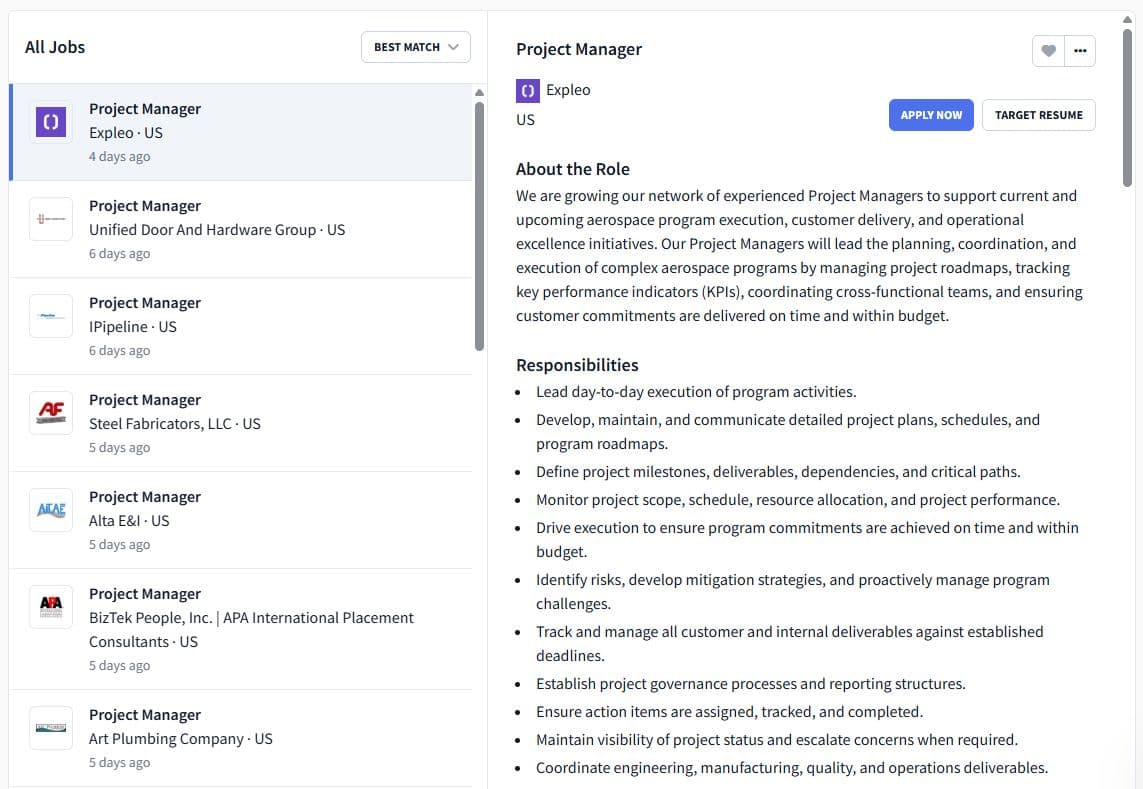
Anyone who has actually hired a project manager will tell you that domain experience is often the deciding factor, an aerospace program manager and a plumbing company's project manager are not close substitutes for each other, no matter how identical the job title reads on paper. Matching on title text without any industry or domain signal is the same fundamental gap I found in Jobright's algorithm: literal keyword overlap standing in for real understanding of fit.
The AI Interview's "Tone" Score Is Dressed-Up Guesswork
Rezi also has an "AI Interview" feature: a live mock interview conducted over your camera and microphone, tailored to a resume and job description, with a scored replay afterward. Setting it up worked smoothly, and notably it wasn't paywalled on the free plan.
The objective metrics it reports are genuinely measurable and held up fine: speaking time split between candidate and interviewer (2:14 vs. 3:30 in my test), average pace in words per minute, and a filler word count. Those are things you can actually compute from an audio track, and I have no complaint with them.
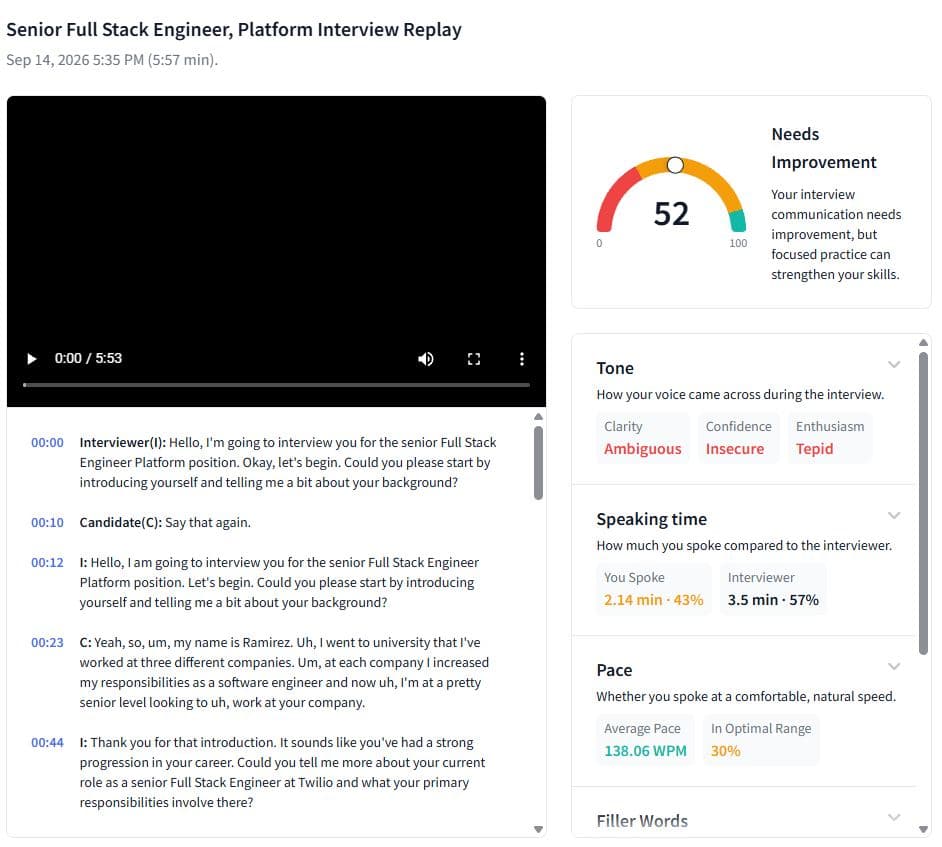
What I'd push back on is the "Tone" section, broken into Clarity, Confidence, and Enthusiasm, each reduced to a single word: Ambiguous, Insecure, Tepid. Tone and sentiment are notoriously difficult for AI models to assess reliably even from clean, full-length audio, and Rezi presents its read on all three with the same confident, precise-looking gauge UI it uses for objectively measurable stats like pace and speaking time. There's no explanation offered for any of the three labels, no supporting evidence pulled from the transcript, just a word.
For context, the answer this was graded against opened with the candidate literally saying "Say that again" to the first question, followed by: "Yeah, so, um, my name is Ramirez. Uh, I went to university that I've worked at three different companies. Um, at each company I increased my responsibilities as a software engineer and now uh, I'm at a pretty senior level looking to uh, work at your company." That's a genuinely rough, filler-heavy answer, so "needs improvement" as an overall verdict is fair. But that's exactly the problem: a short, deliberately messy 23-second response is thin evidence to hang three distinct psychological judgments on, and presenting them as flat, unqualified labels rather than a hedged, uncertain read is the same overconfidence I found everywhere else in Rezi's AI: a system that states things with more certainty than the underlying analysis actually supports.
It's also worth being clear about what this feature is and isn't, especially against how Rezi markets it. Rezi's own AI Interview page promises the simulator "uses your resume and job description to generate questions that top companies actually ask for that specific role." In my test, targeting a real (if fictional) company and job description, the questions were generic: introduce yourself, walk through your current role, nothing that read as researched against the specific employer. The feature grades delivery, pace, filler words, and a guess at tone, after the fact. It doesn't do anything before the interview that resembles company-specific research, and it doesn't attempt to predict the specific questions an interviewer at that company would likely ask given your actual resume and that job description, whatever the marketing copy implies. Practicing your delivery is useful, but walking in without knowing what you're likely to be asked or what the company actually does is a much bigger risk to how an interview goes than a filler word count.
Support Hours Don't Overlap With a US Workday
Rezi's support chat states its hours plainly: Monday to Friday, 8:00 AM to 4:00 PM KST, Korea Standard Time (UTC+9), regular business hours in Seoul, which lines up with the Seoul office listed on Rezi's own About page. For a Pro subscriber on the US East Coast, that's roughly 7 PM to 3 AM local time. On the West Coast, it's the middle of the night straight through to mid-morning, essentially no overlap with a normal US workday at all. Rezi's marketing targets US job seekers specifically, English-language resumes, US-style ATS advice, job listings sourced from US career pages, but support runs on Korean business hours, so if something breaks on your account or a charge needs sorting out during your own working hours, live support isn't there for most of the country most of the time.
Who Is Rezi Actually For?
Rezi is best suited for someone who:
- Wants one well-formatted resume built from an existing PDF, with real typography control, and is comfortable typing it up mostly by hand once the free AI generations run out
- Is willing to pay $29/month or $149 once for full access rather than testing the water on free
- Will proofread and fact-check every AI-generated bullet point before submitting anything
It is not well suited to someone hoping to lean on the "AI Resume Agent" for real back-and-forth help without paying first, or anyone who would accept an AI suggestion without checking it against what they actually did. Given what I saw with the Rust bullet, that checking step isn't optional.
What a Good AI Resume Tool Should Actually Do
Stepping back from Rezi specifically, here's what I think separates a tool that helps from one that just looks impressive in a demo.
1. It Should Never Invent Experience
An AI that adds a specific language, a specific integration, and a specific percentage improvement to your resume because a keyword appeared in a job posting is manufacturing liability for you, not helping you. Every one of Rezi's competitors I've reviewed shares some version of this problem, but that doesn't make it acceptable in any of them.
2. A Score Should Surface Problems, Not Bury Them
A resume score that reaches "Excellent" while a fabricated accomplishment sits inside it isn't measuring what actually matters. If a tool already knows there's an issue worth flagging, that flag belongs on the main screen a user actually looks at, not one click deep behind a secondary button most people will never press.
3. Context Should Be Scoped to the Conversation
An AI agent that references a company or requirement the user never mentioned in the current session isn't being helpful or perceptive, it's leaking state it shouldn't have access to, and presenting it as if it reasoned its way there. That's a trust problem as much as a bug.
4. Matching Should Understand Domain, Not Just Title Text
"Project Manager" means something different at an aerospace company than at a plumbing company. A tool that treats every listing with the same job title as equally relevant is optimizing for search-result volume, not actual fit.
5. Free Tiers Should Let You Evaluate the Product, Not Just See Its Paywalls
A free plan that blocks its flagship feature before a single real message, and blocks its cover letter tool entirely, isn't a trial. It's a locked demo with an upgrade button.
6. Quota and Limit Changes Should Never Be Silent
Locking a user out of a resume they already built, because a different feature quietly pushed their usage over a stated limit with no warning beforehand, is the kind of bug that erodes trust in everything else the product claims about itself.
7. Interview Prep Should Go Beyond Delivery Coaching
Knowing you said "um" too often is a minor fix. Walking into an interview without knowing what the company actually does, or what an interviewer is likely to ask given your specific resume and the specific job description, is the difference between a good interview and a bad one. A tool that only grades how you sounded has covered a small fraction of what real interview preparation requires.
Rezi Alternatives Worth Considering
For a straightforward, free ATS keyword check: Jobscan's free tier (5 scans) covers similar ground to Rezi's keyword targeting, though it has its own accuracy and UI issues I've written about separately.
For application tracking: Huntr remains a solid, genuinely free Kanban board if all you need is to track your pipeline, no AI involved.
For resume building specifically, if you already trust your own editing: Rezi's parsing and typography controls are legitimately good, provided you treat every AI suggestion as a draft to fact-check rather than a finished product, and budget for a subscription since the free tier won't get you far.
For a more complete approach: The pattern across Rezi, Jobscan, and Jobright is the same, each was built around one core mechanic (keyword matching, job matching, or AI writing) and the rest of the product was built around that anchor. When the anchor has reliability problems, as Rezi's does with fabricated content, a score that doesn't account for it, and a context-leaking chat agent, the rest of the platform inherits that risk.
What actually works in a job search is a connected workflow: a strong profile that reflects your real background, job fit analysis that understands domain and not just keyword overlap, resume and cover letter customization that never invents what you haven't done, application tracking, and interview preparation, all working from the same source of truth about who you actually are.
Hirecarta is built around that idea. Resume and cover letter generation draws only from your real, verified background rather than inventing accomplishments to hit a keyword, job fit analysis is conceptual rather than literal title-matching, and coaching and interview prep are included rather than sold separately by the word. It's designed for applying to fewer, better-matched jobs with materials you can actually defend in an interview.
Frequently Asked Questions
Is Rezi worth it in 2026? For a one-time resume build with a clean template, Rezi's free tier will technically get you a PDF. But nearly every feature that makes Rezi "AI-powered," the AI Resume Agent, cover letters, unlimited keyword targeting, most templates, is unavailable on the free plan, and the AI features that are available produced fabricated experience in our testing. At $29/month with no meaningful free trial, that's a hard sell.
Is Rezi free? There is a free plan, but it's capped at 1 resume and 10 lifetime AI generations, not 10 per month. Cover letters require Pro with zero free letters. The AI Resume Agent hit its free message limit before we could complete a single useful exchange on one test account.
Does Rezi's AI make things up? Yes. In testing, Rezi's AI Keyword Targeting added a bullet point claiming production experience with Rust, a language never mentioned anywhere in the source resume, complete with fabricated metrics. Separately, the AI Resume Agent referenced a specific company and job requirements the user never mentioned in that conversation.
Is the Rezi Score accurate? The Rezi Score isn't an ATS compatibility score, Rezi's own marketing treats ATS filtering as a separate topic. In testing, a resume containing a fully fabricated bullet point still scored 94 out of 100, "Excellent," on the main screen a user actually sees. The only hint of a problem was hidden behind a secondary "Explore My Rezi Score" button, and even that didn't catch the fabrication.
What is the best alternative to Rezi? For a purely free ATS keyword check, Jobscan's free tier covers a similar use case. For application tracking, Huntr is free and simpler. For a platform that handles job fit analysis, resume and cover letter customization grounded in your real background, application tracking, and interview prep together, Hirecarta is the most complete option available.
How much does Rezi cost? Rezi Pro costs $29/month, $19/month billed quarterly (about $57 every 3 months), or $149 once for lifetime access. The free plan is capped at 1 resume total and 10 AI generations total, with cover letters unavailable on free entirely.
Is Rezi's job matching accurate? In testing, Rezi's Job Search surfaced results almost entirely by job title rather than industry or domain fit. A search for "Project Manager" returned an aerospace program management role directly alongside Project Manager postings at a door and hardware distributor, a steel fabricator, and a plumbing company, with no distinction made between them.
Can the Rezi Target Resume feature cause problems? In testing, using "Target Resume" from a job listing silently created a second resume that pushed the account past its 1-resume free limit, and the original resume was then locked behind a Pro upgrade paywall with no warning beforehand.
Related Reading
Last updated September 2026. Pricing and features were verified at the time of writing and are subject to change.